
Diamond Converter and Arc fault DEtection for high-altitude operations
Diamond converters and arc fault detection for high-altitude operations. Skylife Engineering coordinated the European DCADE project, which investigated technologies based on diamond semiconductors to address key challenges in the electrification of high-altitude aircraft. The goal was to develop high-voltage converters and arc fault detection techniques to increase the safety and reliability of electrical systems, contributing to cleaner and more efficient aviation.
The Project
Context and Challenges
Skylife Engineering is coordinating a European project aimed at researching a new technology based on diamond semiconductors that will help address some of the major challenges of aircraft electrification, given the technical issues that can arise from operating on electricity at high altitudes.
Concerns about the effects of climate change are also having an impact on the aviation industry. Consequently, there is a growing demand for clean aviation, based on the use of aircraft with zero pollutant emissions. Thus, electric aircraft are becoming increasingly important, with the goal of achieving zero carbon dioxide emissions. The European Commission is working to advance this goal through programs such as Clean Sky 2, under which this project falls.
Advances made in recent years in power semiconductors are driving the adoption of electric propulsion in the industry. The amount of energy managed by the electrical system is expected to increase over the next decade. Consequently, the system will transition from handling a small number of megawatts for small aircraft to handling several tens of MW for long-haul aircraft. The technology for managing this amount of energy is well established in typical terrestrial power distribution networks. However, the concepts and components cannot be directly applied to aviation. The challenge here lies in the required size and weight, as well as the fact that aircraft fly at high altitudes, where air pressure and density are lower.
The evolution of aircraft electrical power management systems toward higher power output is essential in the coming years. In this context, the DCADE project aims to evaluate the use of potential technologies that will enable the use of higher-voltage converters while maintaining power density and arc detection techniques, thereby increasing system safety.
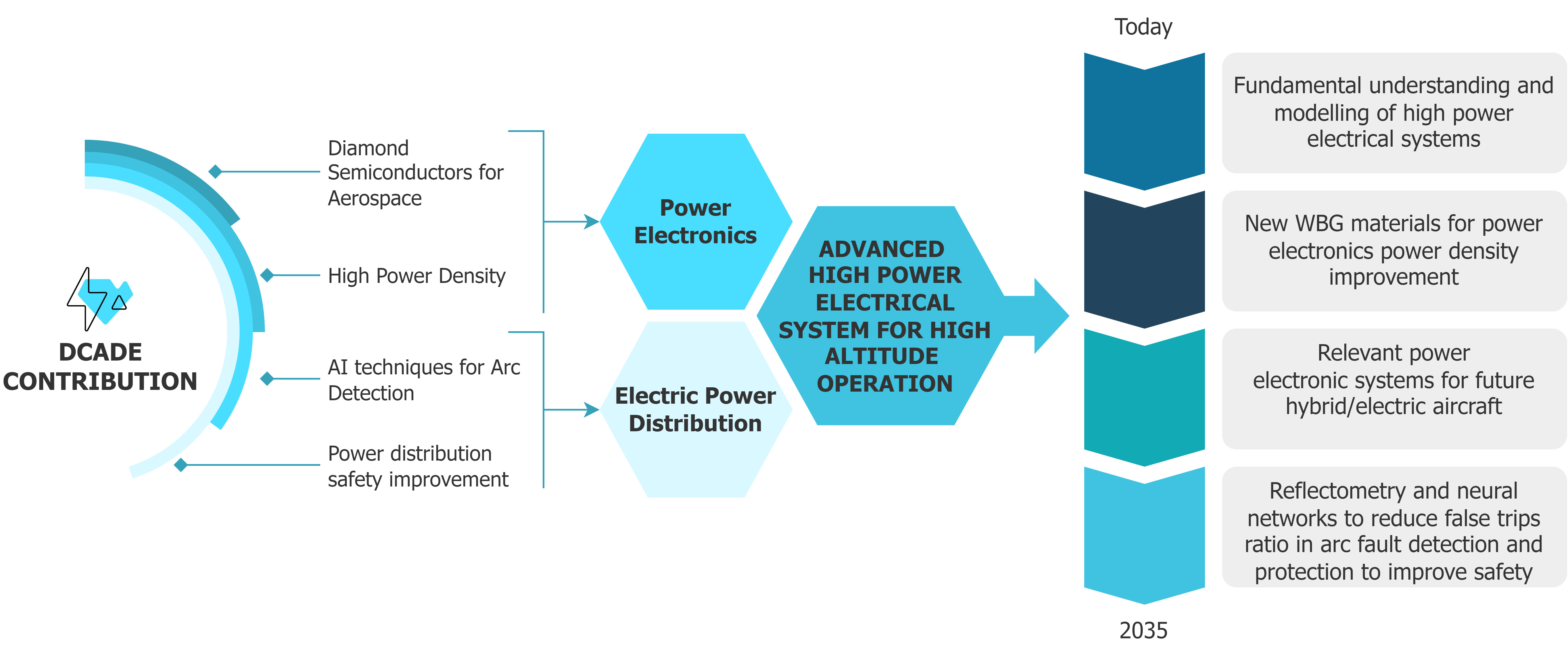
DCADE will focus on two technologies: power electronics and power electronics distribution. The project will develop two demonstrators. The first will be implemented at Skylife Engineering’s headquarters in the Cartuja Science and Technology Park. The other will be carried out at IRTSE’s facilities in Toulouse, France.
Our Proposal
DCADE is funded by the European Union under the Clean Sky 2 program and aims ultimately to advance toward cleaner aviation through the development of more electrified aircraft and, consequently, zero emissions.
The overall objective of DCADE is to evaluate potential technologies and components for electrical systems in aeronautical applications that will enable higher-voltage converters while maintaining power density, as well as arc detection techniques that will increase the reliability and safety of high-altitude, high-power, and high-voltage air conditioning distribution systems.
This project, with a budget of nearly 1.26 million euros, will implement the use of technologies in the development of high-altitude electrical power distribution systems. It also involves the participation of the French entities IRT Antoine de Saint-Exupéry, the Centre National de la Recherche Scientifique (CNRS), and DiamFab.
IRT Antoine de Saint-Exupéry is responsible for advancing the detection of arcing in high-voltage power distribution systems for aircraft. In the field of electricity, arcing faults refer, in simple terms, to electrical discharges through a gap of air or gas between conductors, which can pose safety risks.
Meanwhile, DiamFab and the CNRS are working to develop a diamond-based semiconductor that can be used for electrical power conversion. Semiconductors are devices that contribute to efficient energy management and help transform and control high levels of voltage and current in power electronics converter equipment. Researchers estimate that diamond semiconductors may offer better performance than the technology currently in use, which is based on silicon carbide (SiC) or gallium nitride (GaN).
Skylife, the company in charge of coordination, aims to demonstrate power electronics conversion equipment using the diamond semiconductors that will be produced by the CNRS and DiamFab. In this regard, Skylife’s primary mission is to demonstrate that this technology can be incorporated into power electronics converters.
The Solution
The main challenges of this project center on applying this technology at high altitudes. In such cases, the increase in voltage can more easily lead to the occurrence of electrical arcs. It is therefore necessary to use forced heat dissipation to properly manage thermal elements, since heat can affect the operation of semiconductors and plays a very significant role in power electronics. However, this task is more complicated during flight than on the ground. The goal is to find technological solutions to these two problems.
Diamond-based transistor technology for controlling the flow of electric current is highly innovative and offers technical advantages over the semiconductor technology generally used today. Among these improvements are a higher breakdown voltage—the minimum voltage required for a non-conductive or insulating material to begin conducting electricity—and lower energy losses.
Currently, with the push toward aircraft electrification, the operation of these types of systems at high altitudes presents a new challenge. One must take into account the low air pressure and density at that distance from the ground. At the same time, the specific characteristics of the strict safety and reliability requirements must never be overlooked. The DCADE project will develop power electronics and electrical power distribution technologies for arc detection that will address these challenges, while also investigating the potential of diamond-based semiconductors.
Benefits Achieved
The benefits achieved through this solution are significant:
- Cleaner aviation: The DCADE project will contribute to the development of more electrified aircraft and, ultimately, to zero-emission aviation, which will help address concerns about climate change.
- Diamond semiconductor technology: Research into diamond semiconductors offers technical advantages, such as higher breakdown voltage and lower energy losses compared to traditional semiconductors, which can improve the efficiency of aircraft electrification.
- High-altitude power distribution: The project aims to solve technical challenges related to the distribution of electrical power at high altitudes, which will enable better performance of in-flight electrical systems.
- Enhanced safety: Research is being conducted on the detection of electrical arcs in high-voltage distribution systems, which would improve the safety of electric aircraft.
Financing
The DCADE project, with a budget of more than 1.25 million euros for the consortium, was carried out between 2021 and 2023 with a 100% grant. It was funded by the European Commission under the Horizon 2020 program.

Why Skylife?
At Skylife Engineering, we lead projects thanks to our extensive experience in integrating advanced technologies and our strong commitment to sustainability in aviation. We work closely with each project manager, applying a rigorous process of review and continuous improvement. This approach ensures solutions of the highest quality—safe and effective—that have a real and lasting impact on the industry.





-
SectorAerospace
-
ScopeEuropean
-
CallH2020-CS2-CFP11-2020-01
-
Reference101007868
-
Project Duration2021 - 2023



