
Optimised Electric Network Architectures and Systems for More-Electric Aircraft
The Project
Context and Challenges
Concerns about global warming are driving the aviation industry to adopt innovative technologies for more environmentally friendly flights, as aviation stakeholders have committed to ambitious goals of reducing aviation’s global net carbon emissions by 50% by 2050 compared to 2005. Hybrid-electric propulsion is one of the proposed solutions for achieving this ambitious goal. The introduction of this solution opens up new opportunities and also creates new challenges, such as the need for dedicated thermal management systems (TMS) to cool the electric motors.
Proposal
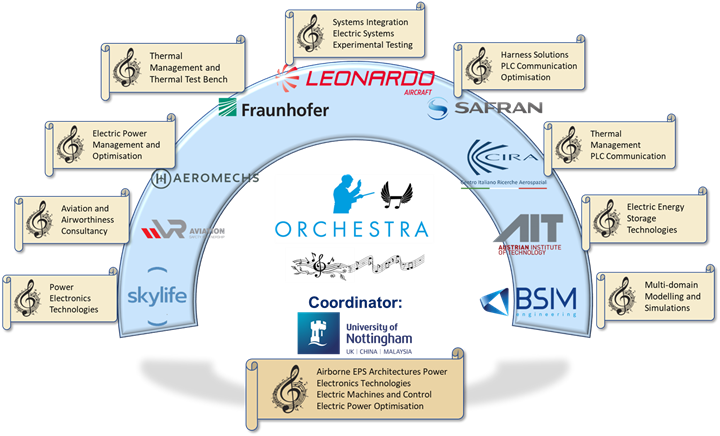
The European Union has co-funded the ORCHESTRA project (Optimized Electric Network aRCHitEctures and SysTems for More-Electric Aircraft) to design new technologies that will enable a 10% increase in efficiency and a 25% reduction in the weight of the electrical power system (EPS) compared to the current state of the art.
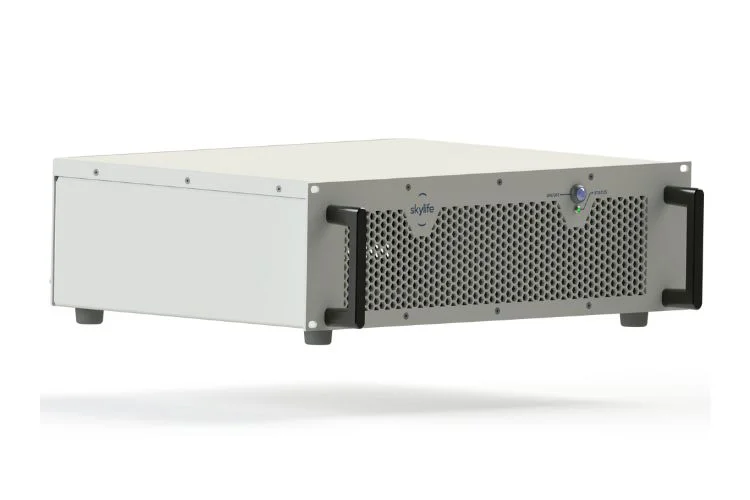
As part of the ORCHESTRA project, Skylife has developed a modular bidirectional Dual Active Bridge (DAB) converter to manage power transfer between the kilovolt direct current (KVDC) bus (1–3 kV) and the high-voltage direct current (HVDC) bus (540 V).
The Solution
The power converter designed by Skylife for this project has one key feature to consider: the high-voltage input, either 1 kV or 3 kV. Generally, for this voltage level, the most common solutions include IGBT (Insulated Gate Bipolar Transistor) modules as semiconductors, due to their ability to withstand high voltage and handle high current. However, in this case, the size and weight of the converter are also critical, and this was the reason for increasing the switching frequency, making it imperative to use faster devices such as SiC MOSFETs (Silicon Carbide Metal-Oxide Semiconductor Field-Effect Transistors), which offer good voltage withstand capability and current-carrying capacity.
The topology chosen for the DC/DC converter was the Dual-Active Bridge converter. This choice was based on the main characteristics of this topology: bidirectional power flow, high efficiency, voltage regulation, galvanic isolation, reduced harmonics, and modularity. It was this last feature that allowed the converter to be used in different modular configurations to operate at an input voltage of 1 kV or 3 kV. When the input voltage is 1 kV, the converters’ inputs are connected in parallel in what is called IPOP (Input Parallel, Output Parallel). When the input voltage is 3 kV, their inputs are connected in series, in what is known as ISOP (Input Series, Output Parallel). Both configurations are shown in the following image.
The converters were designed to achieve the following specifications.
- Nominal Power: 70 kW
- Nominal KVDC Voltage: 1 kV
- Nominal HVDC Voltage: 540 V
- Topology: Dual-active bridge
Financing
The ORCHESTRA project, with a budget of more than 4.8 million euros for the consortium, was carried out between 2021 and 2024 with a 100% grant for the partners. It was funded by the Horizon 2020 program of the European Commission.

Why Skylife?
At Skylife Engineering, we lead projects thanks to our extensive experience in integrating advanced technologies and our strong commitment to sustainability in aviation. We work closely with each project manager, applying a rigorous process of review and continuous improvement. This approach ensures solutions of the highest quality—safe and effective—that have a real and lasting impact on the industry.


-
SectorAerospace
-
ScopeEuropean
-
CallH2020-MG-2020- SingleStage-INEA
-
Reference101006771
-
Project Duration2021 - 2024



